

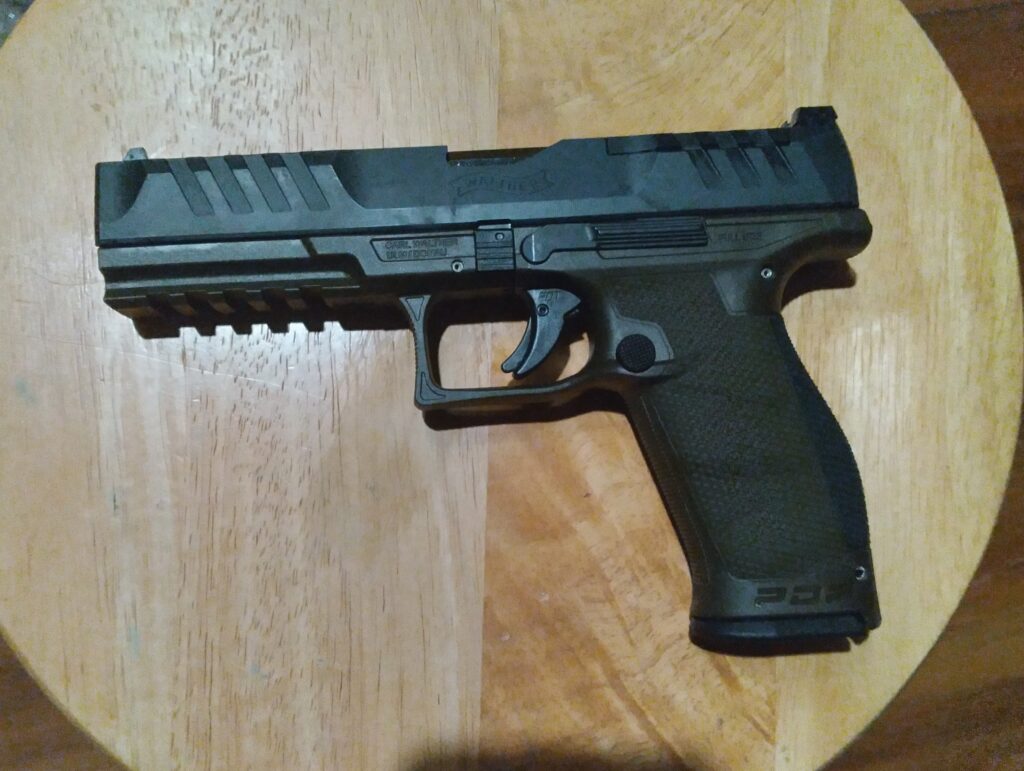
I had a range officer at a local indoor place ask me last month why I kept coming back with the same gun instead of rotating through my usual pile. The gun was a Walther PDP Compact. Answer’s simple — I was still finding things to like about it after eight range sessions, and that doesn’t happen much anymore once you’ve shot as many striker guns as I have over fifteen years, half of it in a duty holster.
Walther’s had a rough go of it in the American market for the better part of two decades. The PPQ was good, genuinely good, but it never got the marketing push Glock and Sig got, and it showed up to the striker-gun party a little late. The PDP is Walther actually showing up on time for once. It launched in 2021, built off the PPQ’s bones but reworked almost everything a serious shooter would touch or look through. Full-size, Compact, and now the sub-compact variants are all out there, and the F-series exists for shooters who want a shorter reach to the trigger without going to a mini gun.
History and where the PDP came from #
Walther’s had a hand in polymer striker guns since the P99 showed up in the late ’90s — that’s the gun that got James Bond off a revolver, if you remember the movie tie-in. The PPQ came later and built a cult following among people who actually shot competitively or carried for a living, mostly because of the trigger. Good trigger, mediocre sights, so-so ergonomics for anyone with hands outside the median range.
PDP stands for Performance Duty Pistol, and the name isn’t just marketing fluff. Walther designed it with input from law enforcement trainers and competitive shooters, and you can feel that in the grip texture and the way the slide serrations are cut. It’s not a from-scratch design — a lot of the PPQ’s internals carried over — but the ergonomics, the optics cut, and the overall fit and finish got a real overhaul. This is the same broad approach Sig took with the P320 to X-series and P365 line, and Glock has been slower to follow with, but Walther actually nailed the execution better than either of those two did on their first attempt, in my opinion.
Specs that actually matter #
The Compact model I’ve put the most rounds through runs a 4-inch barrel, 15+1 capacity in 9mm, and weighs in around 24.4 ounces unloaded. Full-size bumps that to a 4.5-inch barrel and 18+1. Overall length on the Compact sits at 7.3 inches, height around 5.4 inches with the flush mag. Trigger pull on my sample breaks right around 5.5 pounds with almost no takeup slack and a reset you can feel and hear.
Walther ships the PDP with a Superterrain slide texture, which sounds like marketing copy until you actually rack it wet or with gloves on. It works. The interchangeable backstraps come in three sizes, and the frame itself has a slightly different grip angle than the PPQ, closer to 1911 geometry than Glock’s more raked angle. That matters more than people give it credit for. A carry gun should fit hand, not just holster, and too many manufacturers design around the holster market instead of the actual grip.
Optics cut and the sight picture #
This is where Walther actually beat most of the competition to market with something useful. The PDP’s optic cut is a proprietary but genuinely well-thought-out system that accepts a huge range of red dot footprints without a plate adapter stack that raises your sight height over bore into a tower. Trijicon RMR, Holosun 507C/509T, Leupold DeltaPoint Pro — most of the popular footprints drop straight onto the slide with the right plate, and Walther includes several plates in the box.
The rear sight doubles as a co-witness point with most dots, which sounds minor until you’re clearing a house at 2 a.m. and your dot dies or you bump it hard enough to lose zero. I ran a Holosun 507C on mine for about four months and never had a single issue with the fit or retention of the plate system, and that includes some range sessions where I was deliberately trying to knock it loose during draws.
How it actually shoots #
Recoil impulse on the Compact is flat, flatter than I expected given the weight class. Some of that’s the grip angle, some of it’s the trigger letting you stay on target instead of fighting a mushy reset. I ran it through some drills at a range out past the edge of town, off Route 9 near the old quarry, doing Bill drills and some failure-to-stop work at 7 and 15 yards. Splits stayed consistent, and I didn’t see the group opening up the way it does on guns with worse ergonomics once you start pushing speed.
The magazine release is reversible, which matters more than people think if you’re training left-handed shooters or just have big thumbs that ride the release accidentally under stress. Mag drops free every time, no hang-ups, no need to slap it. Slide lock is positive and doesn’t require a death grip to actuate, which some guns in this price bracket still get wrong.
I’ll say this plainly because I think it needs saying — the PDP’s trigger is better than the Glock Gen5’s stock trigger, and it’s better out of the box than a stock P320 too. Not everyone wants to hear that, but I’ve shot enough of all three back to back to stand behind it. Where the PDP loses a little ground is aftermarket support. Glock and the P320 have a decade-plus head start on holsters, sights, and internal parts, and that gap hasn’t fully closed for the Walther yet, though it’s closing fast.
Who this pistol actually suits #
Former patrol guys and current duty-carry folks will get along with the PDP fine — it was built with that use case in mind, and it shows in the controls and the way it handles under a heavy garment. For concealed carry, the Compact model is the sweet spot; the full-size is a duty gun first, and the sub-compact variants trade too much grip real estate for most hands to make sense as a primary unless you’re specifically hunting for deep concealment.
New shooters looking for their first serious handgun could do worse, but I’d point most first-time buyers toward something with a bigger aftermarket and lower price point first, just so they’re not learning fundamentals on a gun that costs more to feed accessories into. If you’re shopping for a first handgun at all, the checklist over on our first-time buyer’s checklist before you walk into a gun shop covers the basics worth knowing before you spend money either way.
If you’re cross-shopping this against the usual suspects, our breakdown of the Glock 19 vs Sig P320 compact 9mm comparison is a decent starting point, though I’d argue the PDP deserves a spot in that conversation now too. And if appendix carry is your setup, check our rundown of the best holsters for appendix carry — Walther-specific holster options have expanded a lot in the last two years, more than people realize.
Reliability and maintenance notes #
I haven’t had a malfunction I couldn’t trace back to ammo or my own grip on this gun, and that’s across roughly 1,800 rounds of mixed FMJ and defensive hollow points. Field stripping is straightforward, similar enough to the PPQ that anyone coming from that platform won’t need to relearn anything. Walther’s owner’s manual and the general safe handling and storage guidance from the NSSF (nssf.org/safety) both apply here without any special caveats — this isn’t a finicky gun that demands a babying routine.
Cleaning interval-wise I run it every 300-400 rounds unless it’s been particularly dirty ammo, and reliability hasn’t dipped even when I’ve pushed that out further during busier stretches. If you’re building out a cleaning kit for a gun like this, our guide to the best gun cleaning kits covers what’s actually worth buying instead of the bundle kits that come with three tools you’ll never use.
Price and where it sits in the market #
Street price on the Compact runs somewhere between $550 and $650 depending on the retailer and whether it comes with the optic-ready package. That puts it right in line with a Glock 19 Gen5 MOS or a Sig P320 Compact with the RXP cut, and honestly the Walther is competing well at that price point rather than getting priced out of the conversation.
Bottom line — this is a gun built by people who actually shot handguns for a living, not just people who read spec sheets. The trigger’s the best in its class right now, the ergonomics finally match Walther’s reputation for build quality, and the optics cut is about as good as anything on the market. It’s not a perfect gun and the aftermarket still lags the big two, but for a carry gun or a duty gun, the PDP earns a real look, and I don’t say that about many pistols released in the last five years.
Here’s the long and short of it: if you’ve been loyal to Glock or Sig out of habit rather than genuine preference, go handle a PDP Compact before you buy your next carry gun. You might walk out with a different opinion than you walked in with.
— Wyatt Coale, Handguns & Concealed Carry Editor