

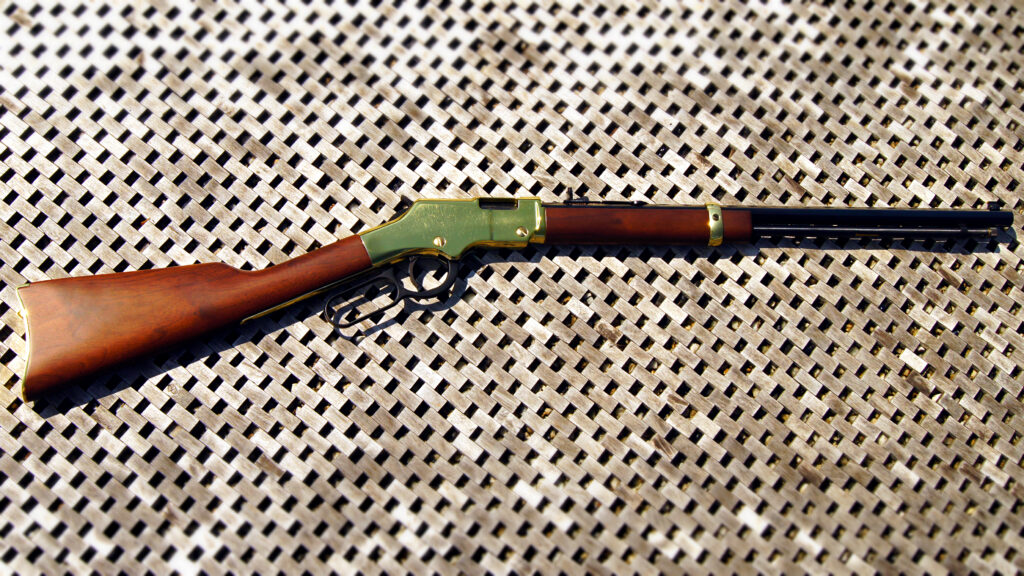
Forty-one rounds through a suppressed bolt gun on a Tuesday morning, then I picked up a Henry Golden Boy .22 off the bench at a public range outside Wickenburg, Arizona, and something in my shoulders just relaxed. No optic. No rail. Just brass, walnut, and a lever. Range time doesn’t lie, and that little rimfire outshot my expectations by a wide margin.
This isn’t a new gun. Henry Repeating Arms has been building the Golden Boy since 1997, and the design itself borrows heavily from the old Winchester Model 1866, the original “Yellow Boy,” right down to the brass receiver that gives it the name. Henry didn’t reinvent anything here. They took a 19th-century concept, tightened the tolerances, and built it in Bayonne, New Jersey, where the company still manufactures the vast majority of its rifles. That matters to some buyers more than others, but I’d argue it’s worth mentioning every time, because rimfire guns built entirely in the U.S. at this price point are thinner on the ground than people assume.
Henry Golden Boy .22 specs and what they mean on the range #
The rifle I ran weighs right around 6.6 pounds unloaded, with a 20-inch octagonal barrel and an overall length just under 38 inches. Tube magazine, 16-round capacity for .22 LR, less if you’re loading .22 Short or Long, which the gun also cycles without issue. That’s a genuine selling point most reviewers gloss over: three cartridge lengths through one action, no adjustment needed.
The receiver is brass, not aluminum, which adds a little heft up front but also means it won’t pit or corrode the way some cheaper alloys do after a humid season in a truck cab. The stock is American walnut, straight-grain on the sample I shot, with a factory-checkered grip panel that’s more decorative than functional. Trigger broke at a hair over 4 pounds on my gauge, crisp with a touch of takeup, no grit. Sights are a semi-buckhorn rear with a brass bead front, which is period-correct and also genuinely usable out to 50 yards without squinting.
Handling the lever action in real conditions #
I ran this rifle across two sessions, one in calm 70-degree weather and one with a stiff crosswind that made the semi-buckhorn sights earn their keep. The action cycled clean both times. Henry ships these with tight tolerances out of the box, and unlike some lever guns I’ve handled over the years, this one didn’t need a break-in period to stop feeling gritty.
Load it through the loading gate on the side of the receiver, which is faster than Henry’s older tube-loading design on the brass-frame models, though a few of their rifles still use the removable inner tube system. Check before you buy if that detail matters to you. Once loaded, the lever throw is short and positive. No stacking, no double-feeds in roughly 400 rounds across both range trips, running a mix of CCI standard velocity and some Federal bulk-pack ammo that tends to be dirtier and less consistent.
Recoil is a non-issue, obviously, this is a .22, but the balance point sits right at the front of the receiver, which makes offhand shooting steadier than you’d expect from a gun this light. Kids and smaller-framed shooters handle it well. It’s also the kind of rifle that doesn’t intimidate a nervous new shooter the way a black rifle platform sometimes does. If you’re building out a first firearm for a teenager, or thinking through what belongs in the safe alongside a defensive handgun, our best gun safes for a first-time owner piece covers storage options worth pairing with a rifle like this.
Accuracy testing at 25 and 50 yards #
At 25 yards off a rest, five-shot groups ran consistently between 0.6 and 0.9 inches with CCI Mini-Mag ammunition. That’s respectable for open sights on a rimfire lever gun; a scoped bolt gun would beat it easily, but that’s not really the comparison anyone’s making when they buy a Golden Boy.
Stretched to 50 yards, groups opened up to somewhere around 1.8 to 2.4 inches, and honestly the groups was tighter than I expected given I was shooting off a bag rest with no magnification. The semi-buckhorn rear sight does its job, but I’ll admit my eyes aren’t what they were a decade back, and a younger shooter with better close vision would probably tighten that further.
Not gonna sugarcoat it: this isn’t a precision tool. It’s a plinking and small-game rifle first, a range-day rifle second, and a “pass it down to your kid” heirloom third. If you want a rimfire built purely to wring out tight groups at distance, there are better options in our best .22LR handguns for practice roundup, though that’s pistols, not rifles, so the comparison only goes so far.
Who the Golden Boy actually suits #
This rifle isn’t for the guy chasing a red dot and a threaded barrel. It’s for the guy who wants something to hand down, something that looks right hanging in a rack over the fireplace and still puts a squirrel down at 40 yards without complaint. New shooters benefit from the low recoil and simple manual of arms. Older shooters who grew up on lever guns tend to gravitate right back to this format because it feels familiar in the hands in a way modern polymer rifles just don’t.
I’ve also seen these show up a lot in small-game and pest-control roles on ranches around central Arizona, where a rancher wants something reliable, quiet-ish with subsonic ammo, and cheap to feed. Sixteen rounds of .22 LR in the tube covers a lot of ground work without a reload.
Where it doesn’t suit: serious tactical or defensive use. That’s not the gun’s job and Henry never marketed it that way. If home defense planning is what brought you here, you’d be better served looking at something like our coverage of the Springfield Armory Hellcat Pro or a proper defensive shotgun setup instead.
Price, fit, and finish compared to the competition #
MSRP sits north of $500, and street price usually lands in the $500 to $600 range depending on region and dealer. That’s a real premium over a basic bolt-action .22 or something like the Savage Axis II, which is a centerfire comparison admittedly, but it makes the point: you’re paying for the brass, the fit, the American walnut, and the Henry name, not for ballistic performance you can’t get cheaper elsewhere.
Fit and finish on my sample was genuinely good. Wood-to-metal fit was tight with no gaps, the brass polished evenly, no tool marks visible on the receiver. Henry backs these with what they call their lifetime guarantee, which is worth reading the actual terms on through Henry’s own site rather than taking secondhand summaries at face value.
Compare that against a used Marlin 39A, which some collectors still argue is the better lever-action .22 on pure mechanical merit. I won’t fully agree. Marlin’s rimfire lever guns have a loyal following and for good reason, but parts and service support have been inconsistent since the Remington ownership years, and Henry’s customer service, in my experience and from what I hear consistently from other range regulars, is simply more dependable right now in 2025.
Maintenance, ammo, and long-term ownership #
Cleaning is straightforward. Standard rimfire cleaning rod and solvent, nothing specialized. The brass receiver will show handling marks and finger oils over time if you don’t wipe it down after range sessions, same as any brass firearm, boat fitting, or belt buckle. That’s cosmetic, not functional, but it’s worth knowing before you buy if you’re precious about a mirror finish.
Ammo compatibility is broad. I ran CCI, Federal, and a partial box of old Remington Golden Bullets I found in a range bag, and the action cycled all three without a hiccup. If you’re new to rimfire ownership generally, our first-time buyer’s checklist before you walk into a gun shop has a section on ammo selection that applies just as much to lever guns as anything else.
For anyone who wants the manufacturer’s own documentation on frame materials, warranty terms, and model variations across their rimfire lineup, Henry Repeating Arms publishes full specs directly, and the NSSF’s consumer resources are a solid neutral reference point for anyone comparing rimfire options generally before they commit to a purchase.
The verdict from the bench #
The Henry Golden Boy .22 isn’t trying to be the sharpest tool in the shed. It’s trying to be the rifle you still own in twenty years, the one that gets pulled out at the family property every fall, the one a grandkid eventually inherits with a story attached to it. On that measure, it delivers. The mechanics are sound, the fit and finish justify the price premium over cheaper lever guns, and the accuracy is more than adequate for what this rifle is built to do.
My one gripe, and it’s minor: at this price, I’d like to see a slightly better set of sights from the factory, even though the semi-buckhorn setup is period-correct and honestly still functional. That’s a small complaint against an otherwise well-built rifle that earns its spot in the safe.
— Colt Reyes, Long-Range Shooting Editor